Why this matters
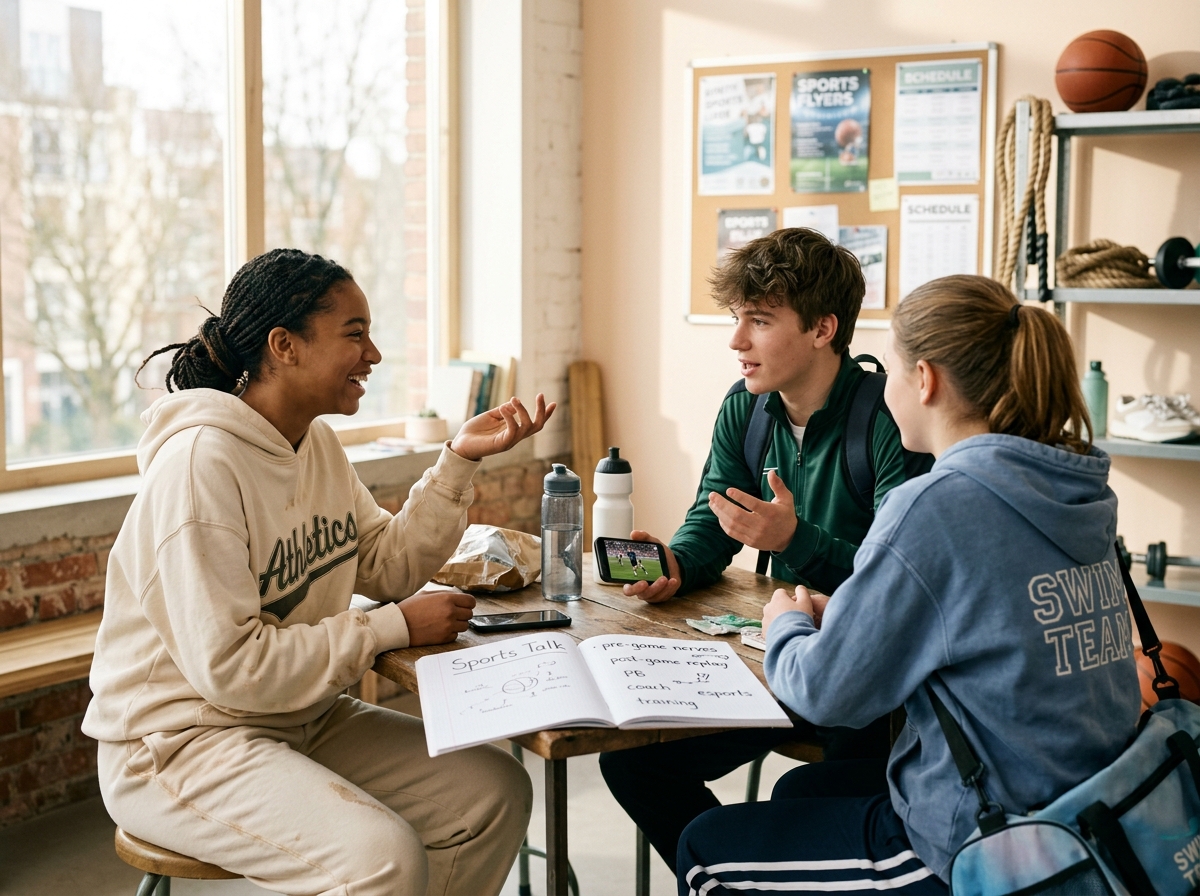
Sports are one of the easiest places to feel fluent in English. The vocabulary is small and high-frequency (game, training, score, win, lose, coach), the structure is repetitive (you have a game; something happens; there's a result), and almost every teen has at least one sport — playing or watching — they can talk about for ten minutes without effort. School English will never give you those reps. The pitch / track / gym / scoreboard does.
These lessons go where you are. Football, basketball, swimming, gym, tennis, dance, climbing, esports — all valid, all welcome. The tutor matches the structure to the sport: team-sport teens get strategy and rival-team chat, individual-sport teens get training cycles and PBs, esports teens get rank and team-comp talk. Pre-game nerves, post-game analysis, training routine — three arcs you'll use for the rest of your life.
What you’ll be able to do
- ✓Name your sport and how often you play / train.
- ✓Give a 3-sentence post-match summary that sounds natural.
- ✓Talk about pre-game nerves in real English ("I was buzzing", "my hands were shaking").
- ✓Describe a personal best or a win you're proud of.
- ✓Ask another person about their training routine.
What a lesson actually feels like
A 14-year-old footballer recounts losing a regional final.
Key vocabulary
Useful phrases by situation
Pre-game
- “I'm so nervous for tomorrow.”
- “My hands are literally shaking.”
- “We've been training hard all week.”
- “If we win this we're in the playoffs.”
Post-game
- “We won 3-1!”
- “We got smoked, honestly.”
- “We were up at half-time and just collapsed.”
- “I scored my first goal of the season.”
Training
- “I train four times a week.”
- “I'm trying to hit a new PB on bench.”
- “My coach is making us run intervals.”
- “I'm taking a rest day tomorrow — body is wrecked.”
Common mistakes & how to fix them
Cultural notes
- ★In the UK, "football" means what Americans call "soccer". "American football" is the helmet-and-pads contact sport. Pick whichever word your tutor uses and they'll match you.
- ★"PB" (personal best) is universal across English-speaking sports — running, swimming, lifting, climbing, even chess. You'll hear it everywhere; using it sounds natural.
Tips from our tutors
“Tell me your last game or training session, beat by beat. Even if you don't have the words, I'll feed them to you as you go.”

“If your sport is something niche — fencing, parkour, archery, equestrian — that's actually better. Niche sports get you talking faster because you have to describe everything.”
Frequently asked
Will the tutor know my sport?+
Do esports / video games count?+
Can I rant about a loss?+
How long is one lesson?+
Beginner, intermediate, advanced
Tell the tutor your level at the start of the lesson and the conversation adjusts. Same topic, different depth.
Name your sport and how often you play. The tutor sticks to fixed phrases ("I play / I train / I watch") and basic vocabulary.
- →Say "I play [sport]" or "I watch [sport]".
- →Say how often (every day, twice a week).
- →Name your favourite team or player.
Real sport talk. Pre-game nerves, 3-line post-match summary, training routine. Use "we won / we lost / it was close" with examples.
- →Give a 3-sentence post-match summary.
- →Talk about pre-game nerves with one specific feeling.
- →Describe a training routine with frequency.
Rant or hype with idiomatic flair. Tactical analysis, opposition strategy, what your team got wrong. Native-pace fan English with slang ("clutch", "smoked", "GOAT").
- →Use sport idioms naturally in context.
- →Hold a tactical-analysis chat ("we needed to press higher").
- →Disagree with another fan's take politely but firmly.
Suggested tutors for this topic



Related topics


Ready to practice sports?
Free 5-minute trial. No card. No commitment.
Start lesson — free →