 Recommended tutor: Sarah
Lesson modules
Pick a focus for today’s session, or start the full lesson and let the tutor decide.
Why this matters
Travel is where most learners discover the gap between their English on paper and their English in the wild. You can read a menu, but the waiter speaks fast. You know the word "gate" but the boarding announcement uses three you've never heard. The fix isn't more grammar — it's hearing real travel English at full speed and getting your mouth to move at full speed back.
These lessons drop you into the moments that matter: a missed connection, a hotel WiFi password, a taxi driver who doesn't know your hotel's name. You'll come out of each lesson with phrases you used in real conversation, not just memorised — that's the difference between airport panic and airport confidence.
What you’ll be able to do
- ✓Check in for a flight, ask about a delay, and find your gate without freezing.
- ✓Handle hotel arrival, special requests, and a smooth checkout.
- ✓Order food in a restaurant abroad — including allergies and substitutions.
- ✓Ask for and understand directions, even when the answer comes fast.
- ✓Use polite phrases that travel well across English-speaking countries.
What a lesson actually feels like
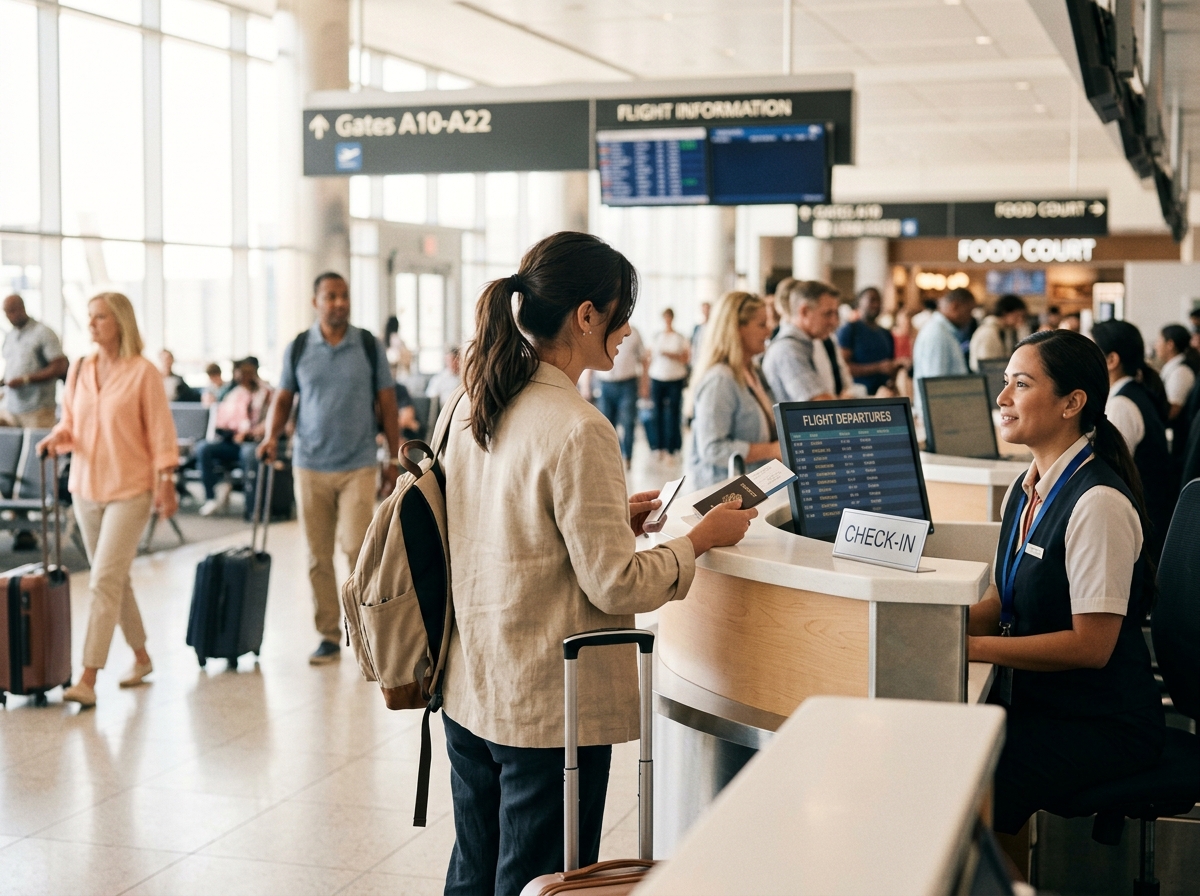
You arrive at the airline counter and your suitcase is one kilo over the limit.
Key vocabulary
Useful phrases by situation
At the airport
- “Could you tell me where gate 27 is?”
- “I'm on the next flight to Madrid — has it started boarding?”
- “Is there a charging point near the gate?”
- “Sorry, I missed the announcement — what did they say?”
In the city
- “Excuse me, is this the right way to the train station?”
- “How long does it take on foot?”
- “Could you write that down for me?”
- “I'm looking for a coffee shop — any recommendations nearby?”
When something goes wrong
- “I think my luggage is missing — who do I speak to?”
- “My flight got cancelled. What are my options?”
- “Could you call the hotel and double-check my reservation?”
- “I don't speak much English — could you say that more slowly?”
Common mistakes & how to fix them
Cultural notes
- ★In American airports, ground staff often respond fastest to specific requests ("I have 30 minutes to my connection — can you help me reach gate B14?") rather than vague apologies.
- ★British transport announcements use understatement: "minor delay" can mean 30 minutes. Always confirm with a person if it matters.
- ★Tipping at hotels varies widely. In the US a $1–2 tip per bag for porters is normal; in much of Europe it isn't expected unless service is exceptional.
Tips from our tutors
Frequently asked
How many lessons until I can travel confidently in English?+
I'm a beginner. Will travel English be too hard?+
Is this American or British English?+
What if I freeze and forget everything?+
Beginner, intermediate, advanced
Tell the tutor your level at the start of the lesson and the conversation adjusts. Same topic, different depth.
First-trip survival kit. Six airport words, three taxi phrases, one polite request. The tutor speaks slowly and accepts pointing-at-words as a valid answer.
- →Order food at the airport gate.
- →Ask "where is gate B14?" and follow the answer.
- →Show your passport and answer the standard questions.
Real conversations on the move. Recovering from a missed flight, getting directions a stranger answered fast, asking for a different room.
- →Handle a delayed or cancelled flight without freezing.
- →Negotiate a small problem (extra bag fee, allergy on a menu).
- →Make small talk with a seatmate or barista abroad.
Travel English at native pace. Cultural nuances, regional vocabulary, idioms travellers actually hear. Push your phrasing toward something a local would say.
- →Match register: formal at hotel reception, casual on a hostel rooftop.
- →Use idiomatic travel English ("layover from hell", "off the beaten track").
- →Read between the lines of a polite British "no" or American small talk.
Suggested tutors for this topic

Related topics


Ready to practice travel english?
Free 5-minute trial. No card. No commitment.
Start lesson — free →