 Recommended tutor: Graham
Why this matters
Hotels are deceptively language-heavy. The check-in itself is short, but the surrounding moments add up: WiFi password, broken air conditioning, an early arrival, a noisy neighbour, a question about breakfast hours. Each of these has a near-fixed English template — once you know the template, everything works; without it, every interaction feels improvised.
These lessons walk you through the entire stay: arrival, every awkward request, and a smooth checkout. The AI plays a polite-but-formal front-desk agent, the way most international hotels train their staff. By lesson three you've handled most of the situations you'll ever meet.
What you’ll be able to do
- ✓Check in cleanly, even when the reservation is under a different name.
- ✓Make polite requests — quieter room, late checkout, extra towels.
- ✓Complain effectively without sounding rude.
- ✓Understand and answer questions about breakfast, parking, late dining.
- ✓Tip and thank staff appropriately for the country.
What a lesson actually feels like
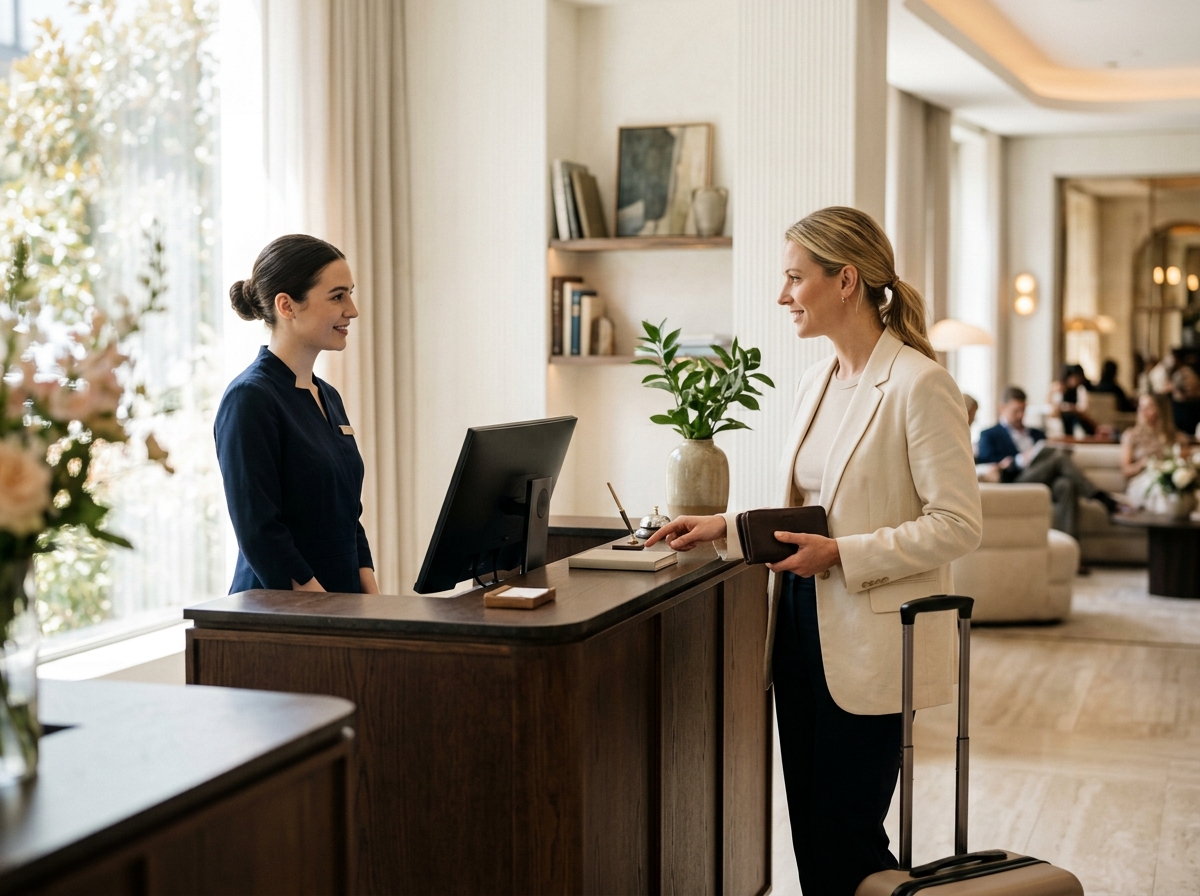
You arrive an hour before check-in time and your room isn't ready.
Key vocabulary
Useful phrases by situation
Arrival
- “I have a reservation under the name…”
- “Could I check in early, if possible?”
- “Is breakfast included in the rate?”
- “Could you store our luggage until check-in time?”
During the stay
- “Could I get more towels sent up?”
- “The AC isn't working — could someone take a look?”
- “There's a noise from the next room — is there a quieter room available?”
- “Could you recommend a good restaurant nearby?”
Checkout
- “I'd like to check out, please.”
- “Could I request a late checkout, please?”
- “There seems to be an extra charge here — could you check?”
- “Would it be possible to email the receipt?”
Common mistakes & how to fix them
Cultural notes
- ★Tipping at hotels: in the US, $1–2 per bag for porters, $2–5 per night for housekeeping, more for the concierge if they help with something specific. In Europe, smaller and only for exceptional service.
- ★Calling the front desk "reception" works everywhere; "concierge" specifically means the bookings/recommendations person.
- ★Don't mention "five-star" or compare hotels in front of staff — it sounds like a threat. If service is bad, ask for the duty manager.
Tips from our tutors

Frequently asked
How is this different from travel English?+
Do hotels in non-English countries actually use English?+
How polite is too polite?+
Beginner, intermediate, advanced
Tell the tutor your level at the start of the lesson and the conversation adjusts. Same topic, different depth.
Polite-but-simple check-in. The tutor walks you through the standard arrival script and lets you confirm key details one at a time.
- →Give your name and check-in dates.
- →Ask about breakfast and Wi-Fi.
- →Take the room key without confusion.
When the stay isn't perfect. AC broken, neighbours loud, late checkout needed. The tutor plays a polite-but-formal front-desk agent who needs specifics, not vague complaints.
- →Make a polite complaint about a real issue.
- →Request late checkout, an extra towel, or a quieter room.
- →Decline an upsell without offending anyone.
Loyalty-status hotel English. Negotiate an upgrade, decode a vague "unfortunately", small-talk the concierge for a real recommendation. Polished register, no rehearsed phrasing.
- →Negotiate a room upgrade or a comp without sounding entitled.
- →Read a politely worded "no" and rephrase the ask.
- →Get a genuine local recommendation from the concierge.
Suggested tutors for this topic


Related topics



Ready to practice hotel & check-in?
Free 5-minute trial. No card. No commitment.
Start lesson — free →